Composer, Sound Artist, Researcher (Buenos Aires, 1953). He developed an extensive work as Professor in the Audiovision Degree Career at the National University of Lanús (UNLa), as well as at the National University of Tres de Febrero (UNTReF), the University of Belgrano (UB), and the “Julián Aguirre” and “Juan Jose Castro” Conservatories at Buenos Aires Province. He’s been a member of various composers’ associations, the Argentine Federation of Electroacoustic Music (FARME), and was associated composer – researcher at the Musical Research and Production Laboratory (LIPM) of the Recoleta Cultural Center (Buenos Aires).
He is Researcher at the Center for Studies in Music & Technology (CEMyT) of the National University of Rosario (UNR). Also in research, he carried out an intense activity at the UNLa where he directed the Center for Sound and Audiovisual Studies and Production (CEPSA) between 2013 and 2024, and from 2000 to 2014 the International Acousmatic and Multimedia Festival “Sonoimágenes”.
He received various awards and distinctions for his artistic activity, including: The Lifetime Achievement Award in Music (2019) by Argentine Award-Winning Artists ‘Alfonsina Storni’ association; The City of Buenos Aires Composition Prize (1996/97); Ibermúsicas Award (2016) for a composition residency in Morelia, Mexico in 2017; National Rostrum Award for Electroacoustic Music (1994); Mention from the National Rostrum of Composers (1987); Ars Contemporanea Composition Prize (1978).
He composed three works for the INA.GRM, Paris (1993, 1994, 2006), two of them GRM Commissions. He was a keynote speaker at the Sonic Arts Network 2004 (De Montfort University, Leicester, UK). He regularly presents his works at Festivals, Conferences and other national and international events. His writings are published by Cambridge University Press (Organised Sound), UNLa, Universidade de Uberlandia (Brazil), and Ariel Editions (Madrid). His music is released by: the Argentina National Fund for the Arts, The Argentine Music Council, UNLa, RedASLA, the University of Tennessee (USA), and the Labels IRCO and Viajero Inmóvil Ex]P[rimental (Argentina), Pogus (New York), CMMAS (Mexico) and Elektrons (Stockholm).
NEWS
-
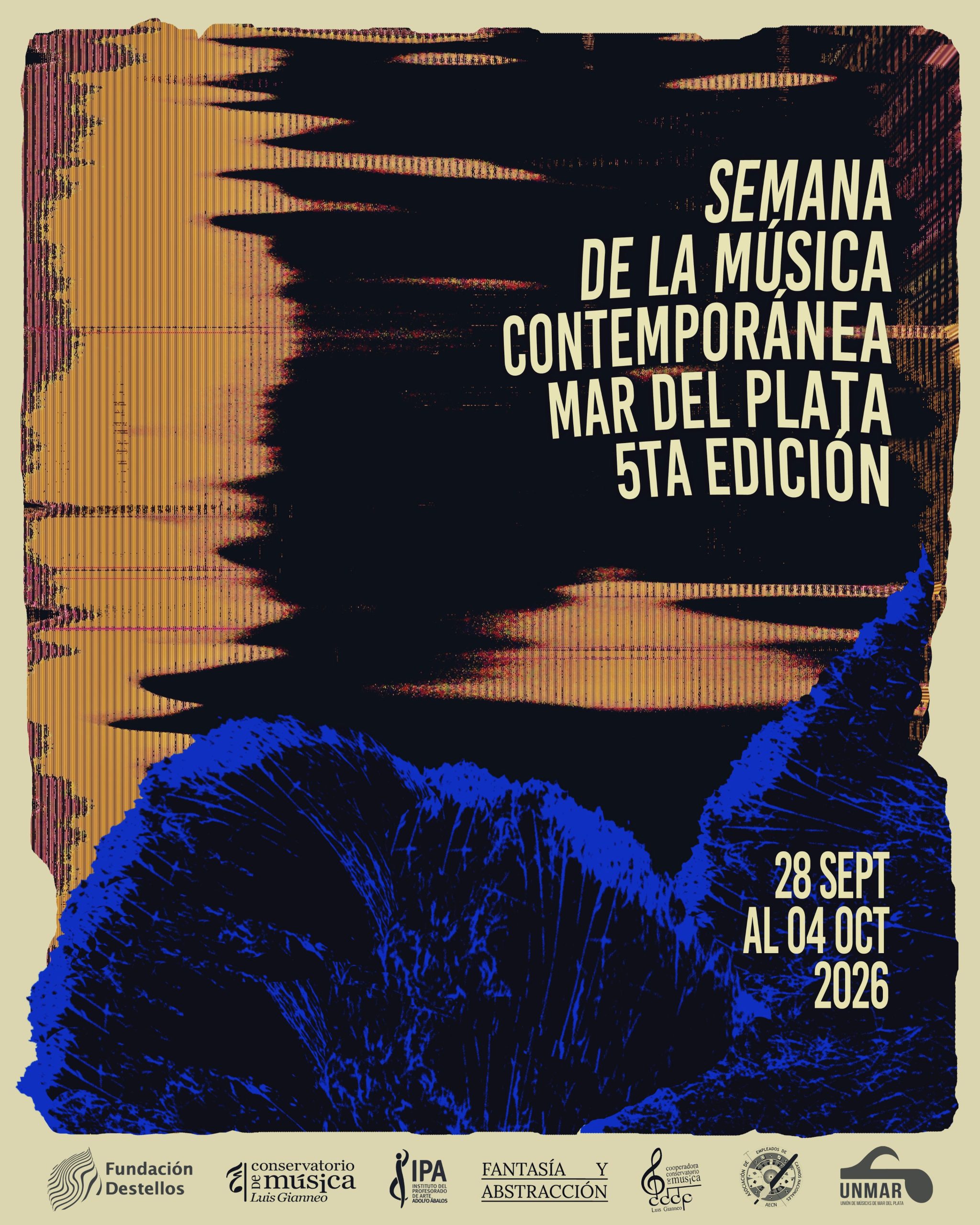
Semana de la Música Contemporánea, Mar del Plata, 28/9 al 4/10 2026
.
Líneas y Puntos de otro tiempo (acusmática, revisión cuadrafónica 2026).
Spira para flauta Paetzold basset y electroacústica (2026, estreno absoluto), con Alejandro Brianza, flauta Paetzold
Bleu Mâts pour Elsa (acusmática, 2026, estreno).
.
A partir del 28 de septiembre y hasta el 4 de octubre se realizará la Quinta Edición de la Semana de la Música Contemporánea de Mar del Plata. Este evento se lleva a cabo desde 2022 con la iniciativa y dirección de la Licenciada Paula Bianucci, profesora del Conservatorio Luis Gianneo, y con el apoyo de la Fundación Destellos dirigida por la Dra. Elsa Justel, y con la colaboración de diferentes entidades y asociaciones marplatenses.
La Semana de la Música Contemporánea es en sí misma un gran Festival que consta de conciertos, conferencias, talleres y diversas muestras multidisciplinarias.
En ese contexto presentaré tres piezas:
El Viernes 2/10 a las 20 hs en la Sala AGRA (25 de Mayo 2847) la primera audición de la revisión cuadrafónica de Líneas y Puntos de otro tiempo (obra acusmática).
El Sábado 3/10 a las 20.30 hs también en la Sala AGRA el estreno absoluto de Spira para flauta Paetzold basset y electroacústica, con Alejandro Brianza como solista en flauta.
El Domingo 4/10 a las 16 hs en el Teatro del Notariado (Av.Independencia 2178) participaré del concierto homenaje a Elsa Justel con la pieza Bleu Mâts pour Elsa (acusmática) también en estreno absoluto.
Todas las actividades son con entrada libre y gratuita, y el detalle puede consultarse en:
https://www.semanamusicacontemporaneamdp.com.ar/#programacionContemporary Music Week, Mar del Plata, September 28 – October 4, 2026
.
Líneas y Puntos de otro tiempo (acousmatic, quadraphonic revision 2026).
Spira for Paetzold basset flute & electroacoustics (2026, premiere), featuring Alejandro Brianza, flute
Bleu Mâts pour Elsa (acusmática, 2026, estreno)
.
The fifth edition of the Mar del Plata Contemporary Music Week will take place from September 28 to October 4. This event has been held since 2022 under the initiative and direction of Lic. Paula Bianucci (professor at the Luis Gianneo Conservatory), with the support of the Destellos Foundation (directed by Dr. Elsa Justel) and the collaboration of various local organisations and associations.
The Contemporary Music Week is a huge Festival in its own right, featuring concerts, lectures, workshops, and diverse multidisciplinary activities.
In this context, I will present three pieces:
On Friday, October 2, at 8:00 PM at the AGRA Hall (25 de Mayo 2847): the first performance of the quadraphonic revision of Líneas y Puntos de otro tiempo (acousmatic work).
On Saturday, October 3, at 8:30 PM, also at the AGRA Hall, the world premiere of Spira for Paetzold basset flute and electronics, featuring Alejandro Brianza as the flute soloist.
On Sunday, October 4, at 4:00 PM at the Teatro del Notariado (Av. Independencia 2178): I’ll take part in the tribute concert for Elsa Justel with the piece Bleu Mâts pour Elsa, also a world premiere.
All activities are open and free. The full schedule can be viewed at:
https://www.semanamusicacontemporaneamdp.com.ar/#programacion
ACTIVITIES – EVENTS – PRESENTATIONS
-
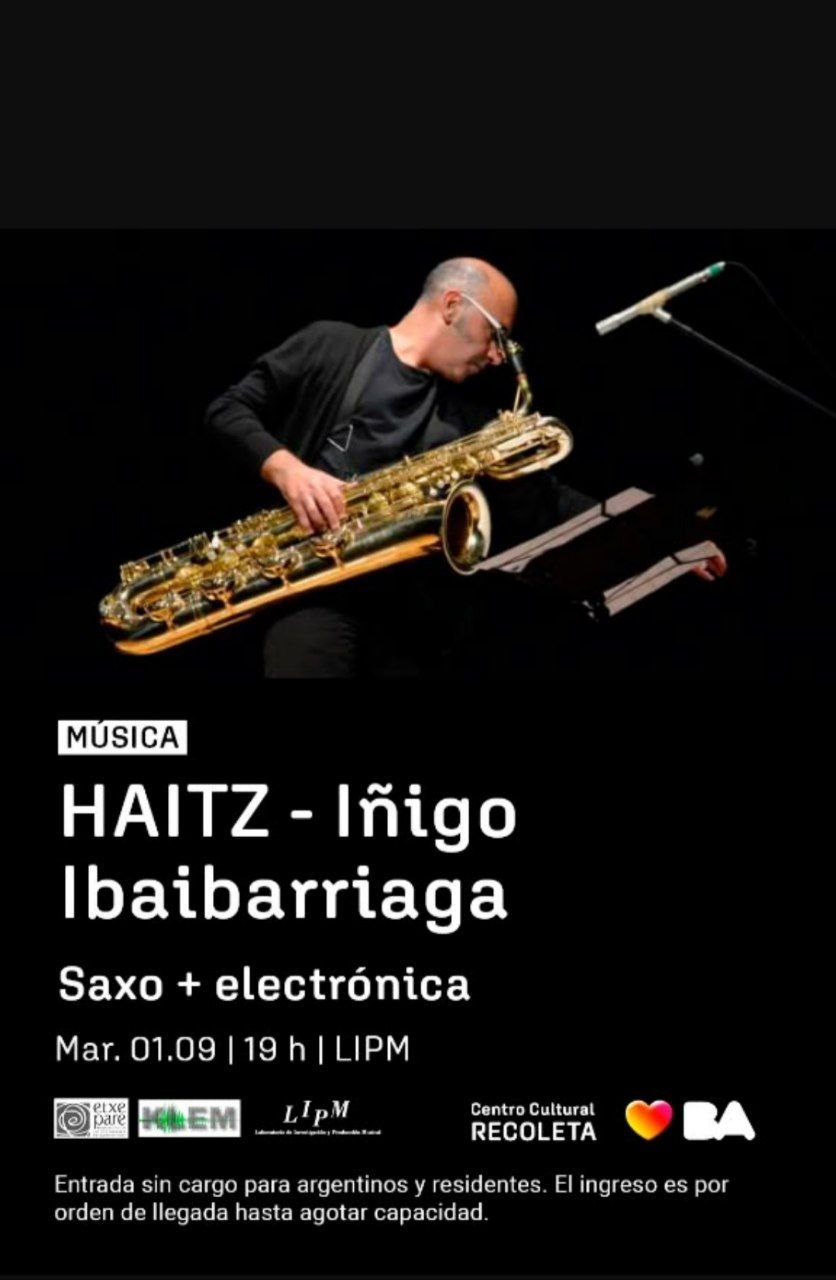
Concierto HAITZ – Iñigo Ibaibarriaga – Sala Octofónica LIPM Centro Cultural Recoleta – 1/9/2026
“Otra Caña” (saxo y electroacústica),
con Iñigo Ibaibarriaga, saxo tenor“Concert HAITZ – Iñigo Ibaibarriaga – Octophonic Hall LIPM – Recoleta Cultural Center 1/Sep/2026
“Otra Caña” (saxophone and electroacoustics), with Iñigo Ibaibarriaga, tenor saxophone.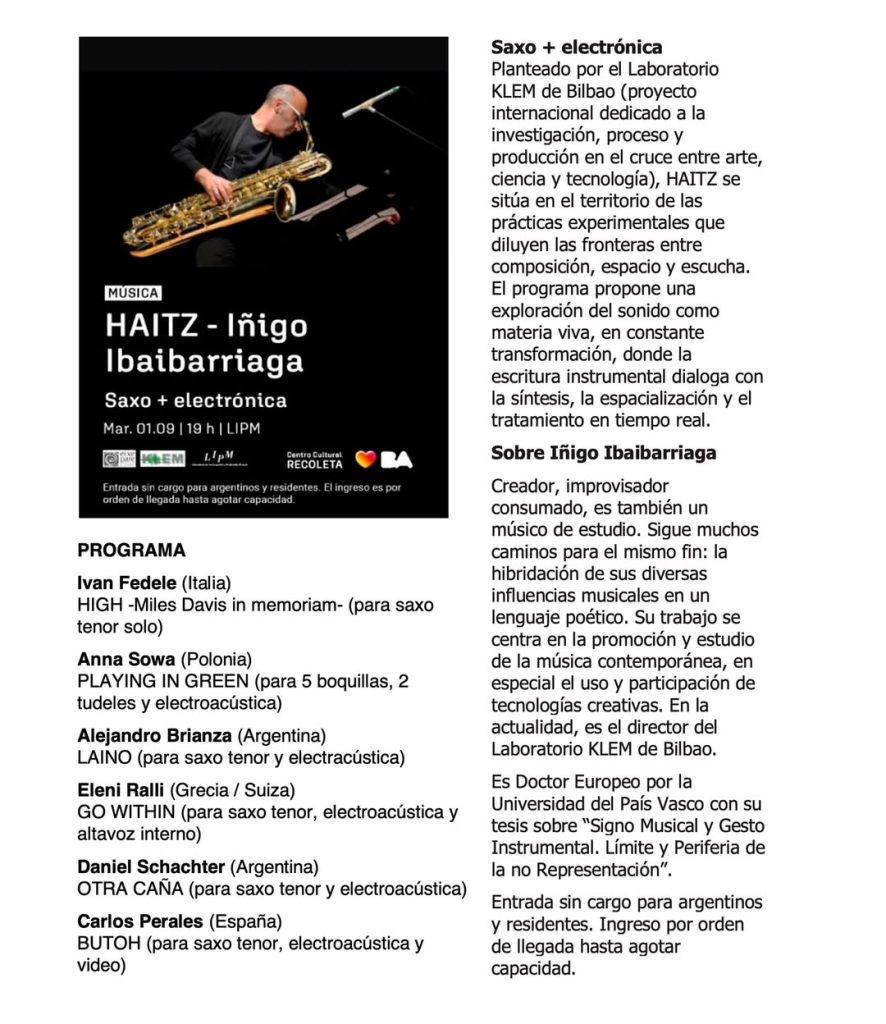
-
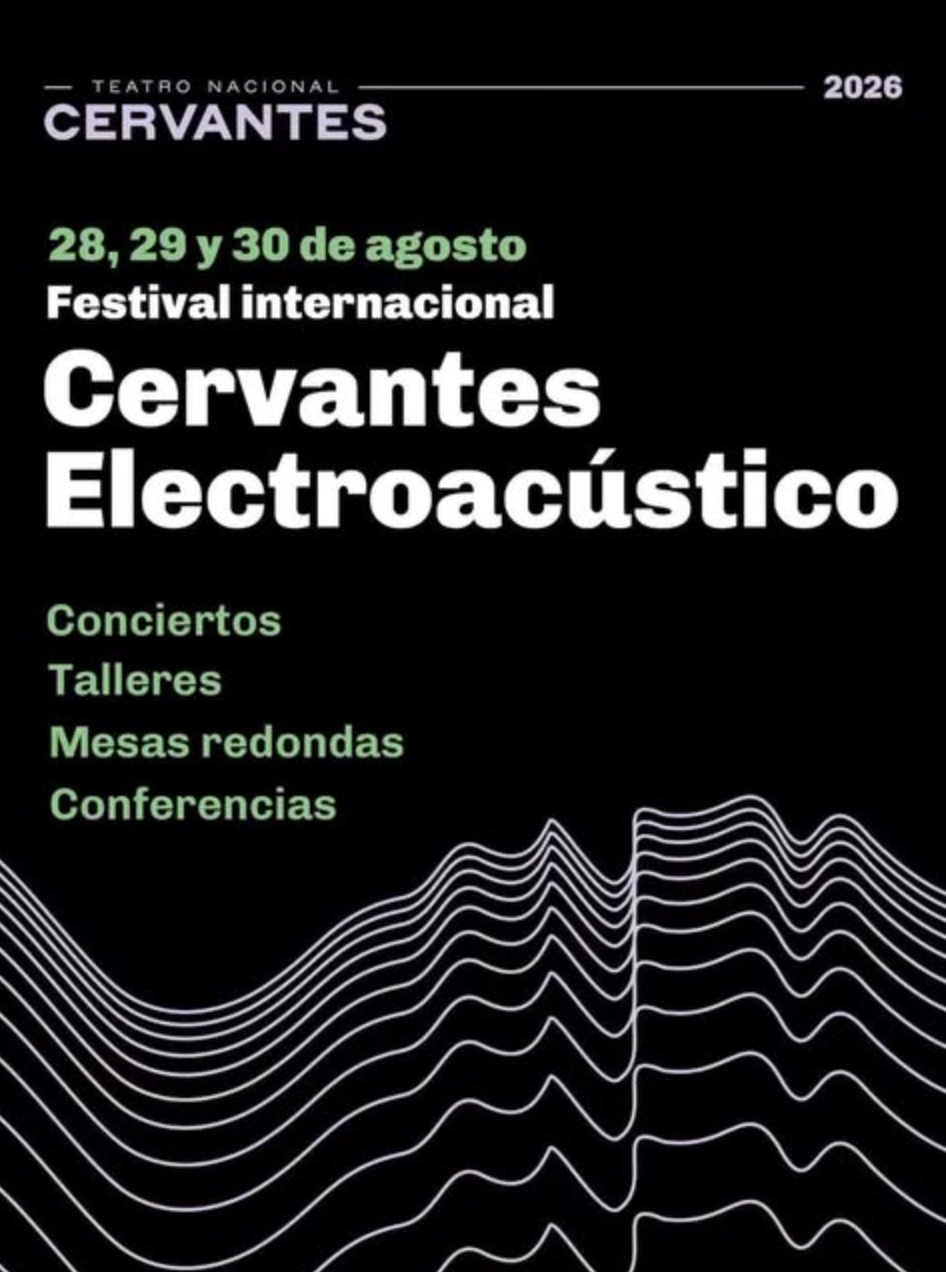
Festival “Cervantes Electroacústico”
Teatro Nacional Cervantes, Buenos Aires 28-29-30 ago 2026
“Otra Caña” (saxo y electroacústica),
con Iñigo Ibaibarriaga, saxo tenor“Cervantes Electroacústico” Festival
Teatro Nacional Cervantes, Buenos Aires 28-29-30 ago 2026
“Otra Caña” (saxophone and electroacoustics), with Iñigo Ibaibarriaga, tenor saxophone.– – – – – – – – – – – – – – – – – – – – – – – – – – – – – –
Otra Caña se presenta (en primera audición en Argentina) en el concierto del Sábado 29 de agosto. Otra Caña propone un juego abierto entre saxofón y electroacústica fija. El instrumentista dispone de diferentes herramientas para dialogar con la electroacústica, desde la fragmentación modular hasta la improvisación libre. La pieza tiene cinco secciones que se suceden sin pausas, cada una con su propio material. Estas son: Prologo, en notación analógica al tiempo cronométrico; Moduli I (dialogo con libertà), Moduli II (dialogo fantastico), Moduli III (dialogo oscuro), cuando la parte instrumental es modular, se indica la cantidad de repeticiones de cada módulo, siendo algunos de éstos espacios de silencio pensados para generar la escucha activa por parte del instrumentista. La sección final Epilogo in loop (dialogo lontano), utiliza la escritura analógica medida en el tiempo, pero se indica que el tempo puede ser libremente más rápido, de modo que el “loop” pueda ser repetido tantas veces como desee el instrumentista, y finalmente se extinguirá junto con la electrónica.
El Programa completo del Festival Cervantes Electroacústico 2026 está disponible en:
https://www.teatrocervantes.gob.ar/obra/cervantes-electroacustico-2/Otra Caña will be performed (in its Argentine premiere) during the concert on Saturday 29 August. The piece offers an open interplay between the saxophone and fixed electroacoustics. The performer employs various tools to dialogue with the electroacoustic part, ranging from modular fragmentation to free improvisation. Comprising five seamless sections, each with its own material, the work opens with Prologo, written in proportional notation against chronological time. This is followed by Moduli I (dialogo con libertà), Moduli II (dialogo fantastico), and Moduli III (dialogo oscuro); in these modular instrumental sections, the number of repetitions per module is specified, with certain modules designated as silent spaces designed to engage the performer in active listening. The final section, Epilogo in loop (dialogo lontano), uses time-measured proportional notation, though the tempo may be taken faster at the performer’s discretion. This allows the “loop” to be repeated as many times as desired before ultimately fading away alongside the electronics.
The full programme for the Cervantes Electroacoustic Festival 2026 is available at:
https://www.teatrocervantes.gob.ar/obra/cervantes-electroacustico-2/
-
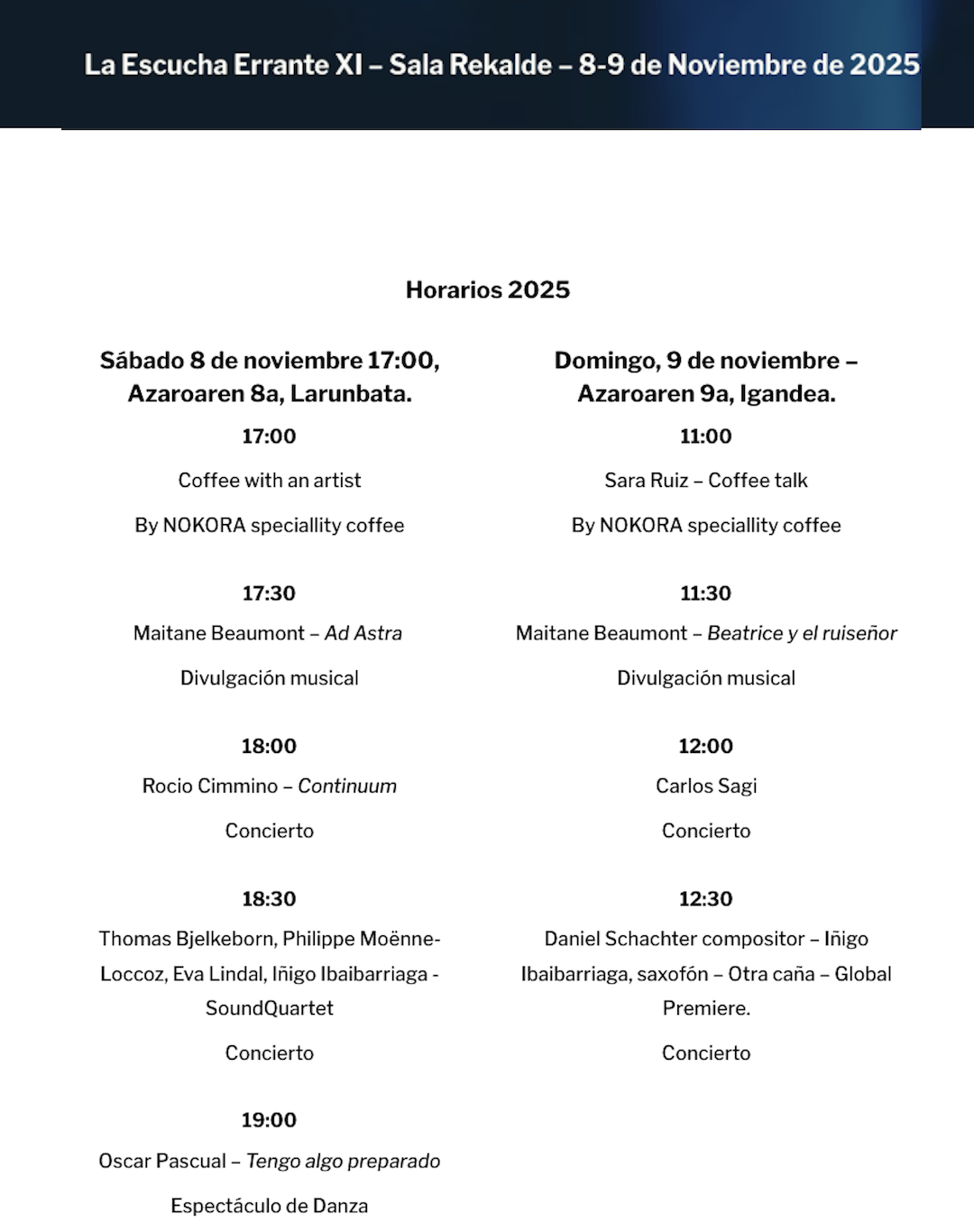
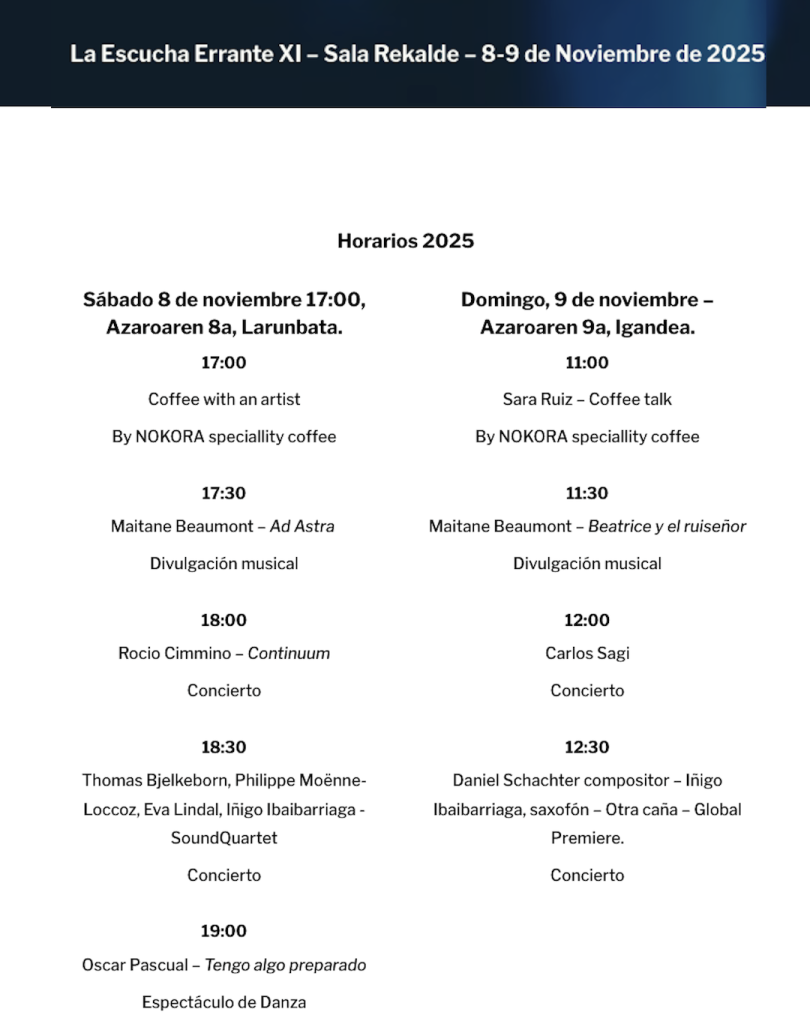
Festival “La Escucha Errante” Sala Rekalde, Bilbao 8/9 nov 2025
Estreno mundial de “Otra Caña” (saxo y electroacústica), con Iñigo Ibaibarriaga, saxo Tenor.World premiere of “Otra Caña” (saxophone and electroacoustics), with Iñigo Ibaibarriaga, Tenor saxophone.
– – – – – – – – – – – – – – – – – – – – – – – – – – – – – –
Otra Caña se presentó como obra de clausura del Festival La Escucha Errante 2025, organizado por el Laboratorio KLEM de Bilbao, España. En la sesión previa al concierto se incluyó una exposición de la pieza a cargo de Daniel Schachter, en diálogo abierto con el público presente en la Sala. Otra Caña propone un juego abierto entre saxofón y electroacústica fija. El instrumentista tiene en sus manos diversas herramientas para dialogar con los sonidos electrónicos, desde la fragmentación modular hasta la improvisación libre. La pieza tiene cinco secciones que se suceden sin interrupciones, cada una con su propio material. Estas son: Prologo, en notación analógica al tiempo cronométrico; Moduli I (dialogo con libertà), Moduli II (dialogo fantastico), Moduli III (dialogo oscuro), donde la parte instrumental es modular, se indica la cantidad de repeticiones de cada módulo. Algunos de esos módulos consisten exclusivamente en silencio, pensados para crear momentos recurrentes de escucha activa, esenciales para el diálogo con la parte electrónica. Desde el inicio hasta este punto el tempo está indicado en aproximadamente a 60 la nota negra. Luego de esto comienza la sección final Epilogo in loop (dialogo lontano), nuevamente en escritura analógica, pero donde se indica que el tempo puede ser libremente más rápido, de modo que el “loop” pueda ser repetido tantas veces como desee el instrumentista, y se extinguirá finalmente junto con la electrónica. Más información puede encontrarse en: https://laboratorioklem.com/zawplab/la-escucha-errante/schedule-2025/
Otra Caña was performed as the closing work at the La Escucha Errante Festival 2025 edition, organized by KLEM Laboratory of Electroacoustic Music, Bilbao, Spain. The pre-concert session included an introductory presentation of the piece, ended on an open dialogue with the public. Otra Caña proposes an dynamic interplay between saxophone and electroacoustic sounds. The performer has various tools at his disposal to engage with the electronic sounds, spanning from modular fragmentation to free improvisation. The piece has five sections that follow one another without interruption, each with its own material. These are: Prologue, in analogue notation to chronometric time; Moduli I dialogo con liberta), Moduli II (dialogo fantastico), and Moduli III (dialogo oscuro), The instrumental score is organized into modular sections, with the performer determining the number of repetitions for each segment. Some of those modules actually consist entirely of silence, thought to create recurring windows of active listening, essential for the interplay with the electronic sounds. From the beginning to this point, the tempo is indicated at approximately 60 bpm. Following this, the final section, Epilogue in Loop (Distance Dialogue), begins, again in analogue notation, with the performer free to accelerando at their own discretion, allowing the loop to be repeated as many times as possible, and finally fading out along with the electronics. More information can be found at: https://laboratorioklem.com/zawplab/la-escucha-errante/schedule-2025/
RECORDINGS
-
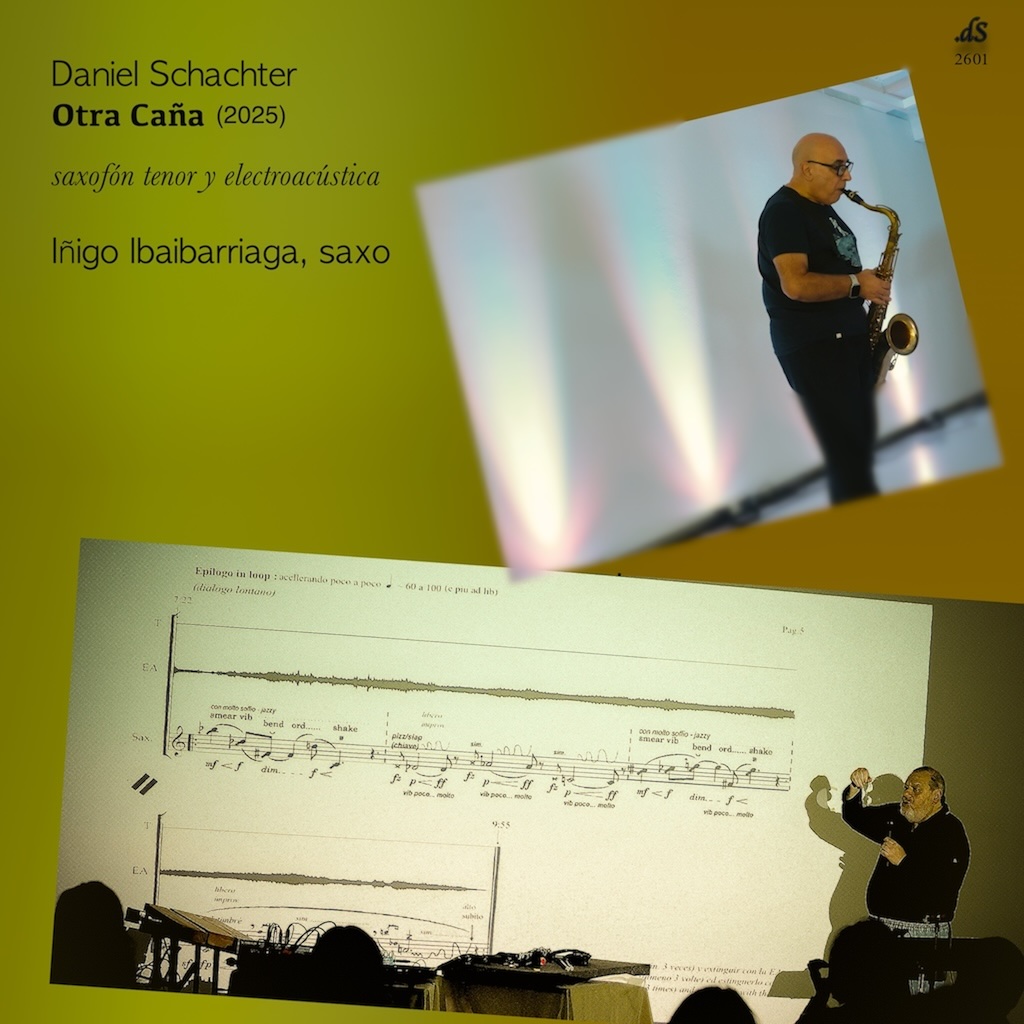
Otra Caña (2025)
Otra Caña (2025) para saxo tenor y electroacústica. Iñigo Ibaibarriaga, saxo. Grabado en Bilbao en ocasión del estreno, Festival “La escucha Errante”, 9 de Noviembre de 2025
-
Travesía
(Composiciones 2016 / 2024) Viajero Inmóvil Ex]P[rimental VIE108-DSCHA
-
Camino Sonoro
CD producido por / produced by : CMMAS, Morelia – Mexico (2016) – CMMAS CD025